
By BRAD HAIRE
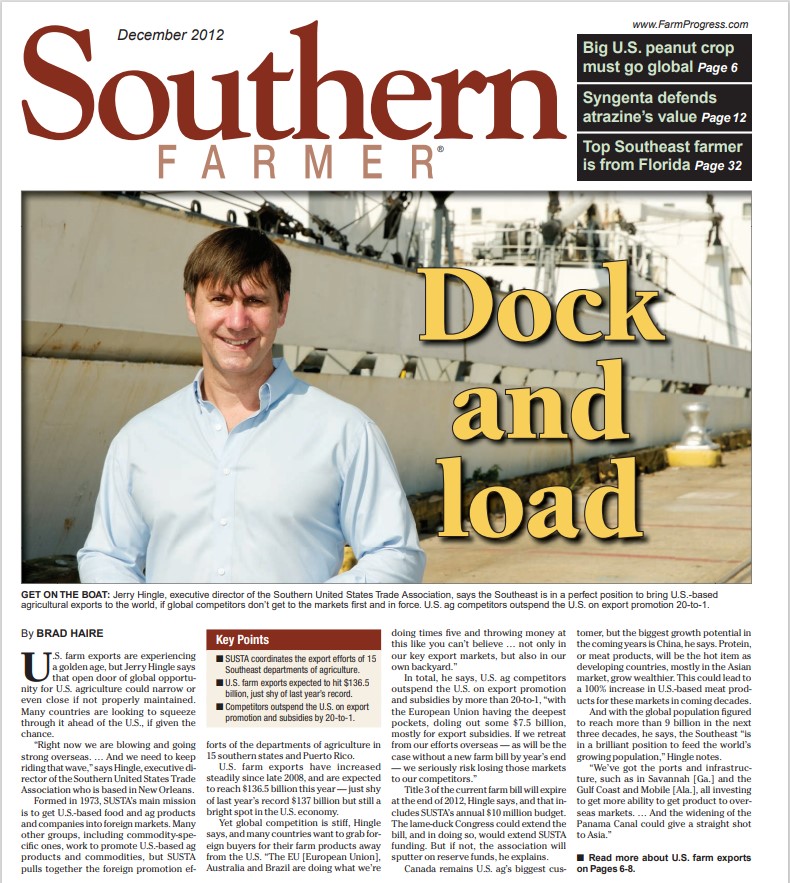
U.S. farm exports are experiencing a golden age, but Jerry Hingle says that open door of global opportunity for U.S. agriculture could narrow or even close if not properly maintained. Many countries are looking to squeeze through it ahead of the U.S., if given the chance. “Right now we are blowing and going strong overseas. … And we need to keep riding that wave,” says Hingle, executive director of the Southern United States Trade Association who is based in New Orleans.
Formed in 1973, SUSTA’s main mission is to get U.S.-based food and ag products and companies into foreign markets. Many other groups, including commodity-specific ones, work to promote U.S.-based ag products and commodities, but SUSTA pulls together the foreign promotion efforts of the departments of agriculture in 15 southern states and Puerto Rico.
U.S. farm exports have increased steadily since late 2008, and are expected to reach $136.5 billion this year — just shy of last year’s record $137 billion but still a bright spot in the U.S. economy. Yet global competition is stiff, Hingle says, and many countries want to grab foreign buyers for their farm products away from the U.S. “The EU [European Union],
Australia and Brazil are doing what we’re doing times five and throwing money at this like you can’t believe … not only in our key export markets, but also in our own backyard.”
In total, he says, U.S. ag competitors outspend the U.S. on export promotion and subsidies by more than 20-to-1, “with the European Union having the deepest pockets, doling out some $7.5 billion, mostly for export subsidies. If we retreat from our efforts overseas — as will be the case without a new farm bill by year’s end — we seriously risk losing those markets to our competitors.”
Title 3 of the current farm bill will expire at the end of 2012, Hingle says, and that includes SUSTA’s annual $10 million budget. The lame-duck Congress could extend the bill, and in doing so, would extend SUSTA funding. But if not, the association will sputter on reserve funds, he explains. Canada remains U.S. ag’s biggest customer, but the biggest growth potential in the coming years is China, he says. Protein, or meat products, will be the hot item as developing countries, mostly in the Asian market, grow wealthier. This could lead to
a 100% increase in U.S.-based meat products for these markets in coming decades. And with the global population figured to reach more than 9 billion in the next three decades, he says, the Southeast “is in a brilliant position to feed the world’s growing population,” Hingle notes.
“We’ve got the ports and infrastructure, such as in Savannah [Ga.] and the Gulf Coast and Mobile [Ala.], all investing to get more ability to get product to overseas markets.… And the widening of the Panama Canal could give a straight shot to Asia.”
 International Trade Associates